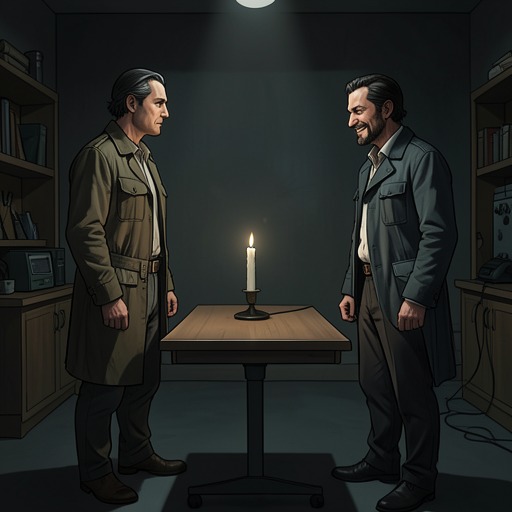
Louis reunites with Lestat in New Orleans
Interview with the VampireLouis reunites with Lestat in New Orleans after years of travel with Armand, and the encounter becomes a final, distorted return to the household they once shared. Rather than restoring the old Louis–Lestat relationship, the reunion exposes how completely time, guilt, trauma, and isolation have transformed both men. Louis finds not the powerful immortal who once dominated his life, but a frightened recluse whose body and mind seem to be collapsing under the pressure of a changed world.
Causes and Return to New Orleans
Louis’s return begins with Armand’s delayed disclosure that Lestat had not died in the Théâtre des Vampires. Louis had believed that Lestat was dead because Armand had previously told him that the vampires connected with the theater had perished. Armand now explains that Lestat escaped on the night Louis fled from Armand and sought out Montmartre Cemetery, assisted by two vampires who had been made by the same master. The revelation changes the emotional direction of Louis’s long exile. He had not thought of Lestat when he burned the theater; his anger had been directed toward Santiago, Celeste, and the others responsible for Claudia’s destruction. Yet learning that Lestat lived makes Louis want to see him again, even though hatred is not the feeling that draws him back.
Louis and Armand return to New Orleans in late spring after traveling through Egypt, Greece, Italy, Asia Minor, and other places chosen according to Armand’s wishes or Louis’s pursuit of art. During those years Louis repeatedly postponed the journey. He feared that New Orleans would revive an old pain, but he also retained a persistent desire for the city and remembered it more intensely in tropical places whose flowers and trees resembled those of Louisiana. When he finally emerges from the railway station, the city gives him an immediate sense of home. Changed though New Orleans is, it still offers familiar oaks, warm pavements, vibrant night sounds, old mansions, magnolias, honeysuckle, roses, and the remembered wilderness of Pointe du Lac.
The Rue Royale produces the most direct contact with the lost past. Louis discovers that the town house where Lestat, Claudia, and he had lived remains recognizable, including its French windows, small balconies, and elegant wallpaper visible through electric chandeliers. He senses Lestat there more strongly than Claudia and becomes certain that Lestat is somewhere in New Orleans. After Armand leaves him, Louis experiences a sadness that is neither painful nor passionate but rich, almost sweet, and binding him to the city. That sadness prepares the reunion as an encounter with memory before it becomes an encounter with Lestat himself.
Finding Lestat
Louis soon notices a sleek, white-faced young vampire walking alone on St. Charles Avenue. Because Armand has learned that the burning of the Théâtre des Vampires made both of them international outcasts, Louis avoids conflicts with other vampires; nevertheless, he begins watching and following this stranger, hoping that the vampire may know Lestat or lead him to him. The young vampire usually goes to theaters or other entertainments that do not interest Louis, but one warm evening his hurried, distressed manner suggests a destination of greater importance.
The young vampire enters one side of a small wooden duplex and kills a woman quickly, without visible pleasure. He then gathers the woman’s child from a bassinet, wraps the baby in a blue wool blanket, and carries it into the street. The action leads Louis to an overgrown property enclosed by a vine-covered iron fence. Beyond the garden stands a decaying house with peeling paint, rust-caked galleries, high empty windows, and dark grounds that isolate it from the surrounding small houses, grocery, and bar. Louis climbs the fence and approaches the long front porch, following the sound of the baby’s cries.
Inside, the scene is deliberately incompatible with ordinary comfort. Despite the heat and the breezeless evening, a fire burns in the parlor while every window is shut. The young vampire sits near another vampire, whose slippered feet press against the grate and whose trembling hands repeatedly pull at the lapels of a shabby blue robe. An oil lamp burns beside the wailing child, while dead cats lie scattered in the dust. The room also contains a deteriorating coffin, yellow newspapers, bones, rotting animals, flies, and the stench of decay. These details establish that Lestat’s existence has become a form of enclosure rather than freedom: immortality has not preserved his former magnificence but has trapped him amid the signs of death.
The Recognition and Encounter
Through the dusty glass Louis first recognizes Lestat’s profile, then struggles to reconcile that profile with the figure before him. Lestat’s old scars have nearly disappeared beneath smooth skin, but his back is bent, his body trembles, and his voice has become thin and high-pitched. He complains about being abandoned and begs for wood to keep warm, even though it is summer. The young vampire angrily urges him to go out and hunt something other than the miserable animals surrounding him. Lestat’s dependence on this younger vampire, who functions as a hostile nurse or caretaker, reverses the old power arrangement between Lestat and Louis.
Louis knocks on the window, and Lestat immediately identifies him, calling his name and ordering the young vampire to let him in. When the window opens, Louis recoils from the room’s sweltering heat, insects, and the remains of dead animals, even as Lestat reaches for him with desperate happiness. Tears run down Lestat’s face, and his strange smile expresses joy so painful that it becomes almost indistinguishable from suffering. Louis tells him that he has come to see him, but gently pushes Lestat’s hand away and turns toward the baby, whose terror and hunger have intensified its crying.
Louis lifts the child, loosens the blanket, pats it, and rocks it until it quiets. A fly lands on the baby’s forehead; Louis kills it instinctively between his fingers. The child’s extraordinary blue eyes and growing smile confront Louis with an innocence he has never before brought death so close to. Holding the baby produces a sorrow even stronger than the sadness that had taken hold of him on Rue Royale. He pulls the young vampire’s chair toward the fire and sits there with the child, while Lestat remains overwhelmed by the fact of Louis’s presence.
Lestat’s speech reveals both recognition and confusion. He says that he has dreamed of Louis’s coming, then struggles to speak of Santiago and insists that he did not mean to let the theater’s vampires carry out their plans. When he declares that Claudia should never have been one of them, he speaks of vampire identity as a collective “Us,” but his words also erase Claudia from the emotional reality of the room. For Louis, she suddenly seems like an impossible and private dream, too precious and too distant to entrust to anyone. Louis tells Lestat not to fear him and denies that he has come to cause harm, but when Lestat asks whether Louis has returned to him, Louis answers that he has not. The reunion therefore contains recognition without restoration: the past is reopened, but the former relationship is not resumed.
Fear, Care, and Departure
The encounter reaches its most intense point when a siren approaches through the street. Lestat reacts with overwhelming physical terror, covering his ears, grimacing in pain, and gripping Louis so tightly that he hurts him. The room fills with the flashing red light, while the baby also begins crying in fear. Lestat presses his head against Louis’s chest and begs him to stay and help him. The sound reveals how radically Lestat has become estranged from the modern world. The immortal figure who once appeared as a stately gentleman in a black cape, singing opera and radiating pleasure in life, now experiences technological change as an assault from which he can retreat only into darkness.
Louis does not tell Lestat that he is immortal or that nothing except his own retreat prevents him from going outside. He also does not remind him that the room displays unmistakable signs of inevitable death. His silence is neither simple forgiveness nor renewed loyalty. It is a refusal to impose an explanation on Lestat’s terror, and perhaps a recognition that the former Lestat cannot be recovered by argument. After the siren passes, the room returns to its flies, festering rat, fire, and child. Lestat straightens briefly only to sink back into his chair, asking whether Louis will stay and visit again.
When Louis prepares to leave, he realizes that he is carrying the baby with him. Lestat asks him to return, but Louis turns away and exits quietly. From the street he sees Lestat hovering at the window as though afraid to go outside; Louis understands that Lestat may not have left the house for a very long time and may never do so again. Louis then returns the baby to the small house from which the young vampire had taken it, leaving it in its crib. His brief act of care contrasts with the violence that brought the child into the scene and marks the limit of his intervention: he can protect the baby for a moment, but he cannot rescue Lestat from the life he has made around himself.
Consequences and Meaning
Louis tells Armand about the meeting only later, perhaps a month afterward, because time has lost its ordinary meaning for him. Armand is astonished that Louis did not mention it sooner, and asks whether Louis felt any desire for revenge. Louis answers that Lestat has already encountered a perfect revenge: he is dying of rigidity and fear, unable to accept the present. His condition is not the serene vampire death Armand once described in Paris but something clumsy and grotesque, resembling human old age. Louis therefore interprets Lestat’s survival as a punishment enacted through psychological and bodily collapse rather than through Louis’s violence.
The reunion also changes the meaning of Louis’s return home. New Orleans initially offers beauty, memory, and the possibility of remaining there forever. The old house on Rue Royale seems to contain Lestat’s presence, and the city’s sadness gives Louis a quiet satisfaction. Yet finding Lestat converts memory into witness. Louis sees that the past has not been preserved inside the house; it has decayed there. The child in his arms, Lestat’s terror at the siren, the dead cats, the ruined coffin, and the flies on the rat all place innocence, immortality, and death in the same confined room.
Louis leaves without revenge and without reconciliation. He has come to see Lestat, not to resume the old bond, and his compassion remains sharply bounded by exhaustion and estrangement. Lestat’s plea that Louis has come home to him is answered by refusal, while Louis’s final act is to return the child rather than remain with the vampire who once defined his existence. The reunion thus functions as a terminal encounter: it confirms that Lestat lives, but shows that the life he possesses has become a grotesque retreat from history, sensation, and human change.